
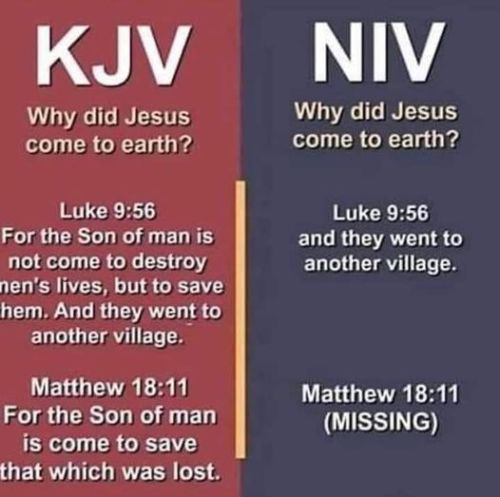
There is a post making its way around social media, warning Christians that their non-KJV Bibles are removing words and verses from the inspired text. Some of the rhetoric is meant to shock and alarm believers that their modern versions of the Bible (NIV, ESV) have “watered down” the true text of the Bible and are not to be trusted, because they have “taken away” from the Word of God. Let me display the graphic and quote the post, and then I’ll comment.
VERY CRITICAL ALERT!!!
NIV was published by Zondervan but is now OWNED by Harper Collins, who also publishes the Satanic Bible and The Joy of Gay Sex.
•The NIV and ESV has now removed 64,575 words from the Bible
including Jehovah, Calvary, Holy Ghost and omnipotent to name but a few…
•The NIV and ESV has also now removed 45 complete verses. Most of us have the Bible on our devices and phones especially “OLIVE TREE BIBLE STUDY APP.”
•Try and find these scriptures in NIV and ESV on your computer, phone or device right now if you are in doubt:
Matthew 17:21, 18:11, 23:14;
Mark 7:16, 9:44, 9:46;
Luke 17:36, 23:17;
John 5:4; Acts 8:37.
…you will not believe your eyes.
•Refuse to be blinded by Satan, and do not act like you just don’t care. Let’s not forget what the Lord Jesus said in John 10:10 (King James Version).
There is a crusade geared towards altering the Bible as we know it; NIV, ESV and many more versions are affected.
•THE SOLUTION:
If you must use the NIV and ESV, BUY and KEEP AN EARLIER VERSION OF the BIBLE. A Hard Copy cannot be updated. All these changes occur when they ask you to update the app. On your phone or laptop etc.
Please spread the word…
First of all, there’s a mix of truth here. For in fact, newer versions of the Bible like the New International Version (NIV), New American Standard Bible(NASB), and the English Standard Version (ESV) are continually undergoing a revision process. This in itself is not particularly alarming. (The so-called 1611 King James Version [KJV] has also undergone revision over the years; a facsimile copy of an original 1611 is unreadable for the most part.) Most of the time, these revisions amount to small corrections or changes. One of the bigger revisions of the NIV took place in 2011, when translators decided to avoid the use of masculine words when the gender was unspecified (“anyone” instead of “any man”). This caused this revision to be called a “gender neutral” Bible, subject to much conservative criticism as a “woke” Bible (although I’m not entirely sure that term was much in use back then). It did still refer to God as “he” and “Father.” It was not successful, and the NIV has since moderated its revisions.
The post correctly states that if you use certain electronic Bible apps, it will update to the current revisions. This is important to remember. Now on some Bible apps, you can purchase a specific edition. For example, on one of my apps (Pocket Bible), I was able to purchase the 1984 NIV, which corresponds to my print copies. On Logos Bible Software, I purchased both the 1977 and 1995 editions of the NASB. But most of the time, I like to use hard copies of Scripture anyway.
The translation process of the Bible from its original Hebrew and Greek manuscripts has to contend with thousands of hand-copied documents, some older and some more recent. To make a complex story simple, when the King James Version was translated, the manuscripts on hand were relatively recent. Since that time, there has been a mass discovery of older manuscripts that illuminated some of the changes that had taken place over the centuries.
Ancient scribes typically added commentary and marginal notes, cross-referencing with other Scriptures, and harmonizing parallel passages. Some of these made their way into the text (e.g., 1 John 5:7). Modern Greek editions rightfully remove these accretions, either by putting them in footnotes as alternate readings or eliminating them entirely.
For example, in the graphic above, Matthew 18:11 is cited. And yes, it is completely missing from the ESV and NET (New English Translation) or bracketed with a note in the NIV and NASB. But was it nefariously “removed”? No, the truth is more innocent and actually the reverse. At some point, manuscript copiers added “For the Son of Man has come to save that which was lost” either in the margin or text of Mattew 18. Where did they get that verbiage? From the parallel passage of Luke 19:10. Earlier manuscripts do not have that phrase in Matthew 18. Eventually, the sentence makes its way into the Matthew passage to harmonize it with Luke, and the KJV, based on later manuscripts follows suit.
I find it interesting that in accusations like this, it is always that verses are removed, but what if the newer manuscripts added those words? Is that not also a violation of the Word of God?
The accusation is always that verses are removed, but what if the newer manuscripts added those words? Is that not also a violation of the Word of God?
M. Graham Knox
Think about this. If the publishers wanted to remove “the Son of Man came to seek and save the lost” from the Bible, wouldn’t they have done it in both locations? The same can be said for most such revisions.
Now, there’s a whole other debate about the validity of the older families of manuscripts vis a vis the “Received Text” upon which the KJV is based, but that’s a debate for another time. I happen to believe that the textual critics who have done remarkable research into the earliest manuscripts have served the church well.
As to the initial accusation of the ownership of the NIV, from Zondervan to HarperCollins, this is the reality of modern-day economics. Many “Christian” companies end up being acquired by larger corporations, and this is the way of it in this “wheat among the tares” world in which we live. There is enough actual, credible biblical scholarship to hold publishers’ feet to the fire, that if there were a wholesale alteration to the NIV or ESV that instrumentally changed the message of the text, we’d hear about it.
So, my brothers and sisters, let not your hearts be troubled. If you prefer your King James Version, so be it. But if you prefer more modern translations that are based on solid, conservative biblical scholarship and the oldest and best manuscript evidence, don’t let someone alarm you into abandoning your Bibles. God promised to preserve his Word (1 Peter 1:24-25), and he has.
 ordo salutis
One response to “Beware of scare tactics”
Another factor in the current Christian publishing world is that a younger generation is managing publishing and come with weaker theological understanding than the former generation.
LikeLike